Word card games are ideal for encouraging familiarity with the most common sight words. Children need more than phonemic understandings to become successful readers and writers. Sight word knowledge is crucial. My word games are based on the Dolch Words, Magic Words* and Oxford Words.** While some children with very good visual memories, can see a word once and know it thereafter, there are also children who need to see a word up to 50 times (or more), before they know it and can recall it instantly. A classroom program that incorporates high frequency words in word games, will provide opportunities for students to see and say the most commonly used words every day (and have fun with them).
*More information about Magic 100 Words (and the 2nd 100 Magic Words), is available from the website
www.magicwords.com.au
**More information about Oxford Words (top 354 high frequency words used by Australian children in their writing), is available from the website
www.oxfordwordlist.com/pages/search.asp
Wild Words and Pet Words
My experiences in teaching have led me to think there may be a place for a new collection of sight words for the classroom. After using the Dolch Words and the Magic 100 Words in classrooms, I thought shorter lists might be easier for younger students to come to grips with. My lists are also based on the most common words in English , but they exclude the easily sounded out words such as 'get', 'but' and 'had'. Included are words that require phonemic understandings other than just the consonant sounds and the short vowel sounds. These are true sight words, that readers will have difficulty with if they try to sound them out without prior phonics knowledge. I have called these the Wild Words. I also plan to place the words with easily recognisable rimes in another collection of word lists for early readers to learn and recognise automatically. These will be the Pet Words. My games will be designed around my lists, but teachers should find it easy to select games and activities for their students' needs whether using these, the Dolch word lists, the Magic Words, Oxford Words, or any other combination of words. Look at the Wild Words lists to determine which games and activities are most appropriate.
Then select games and activities that include the words you need to provide experiences with.
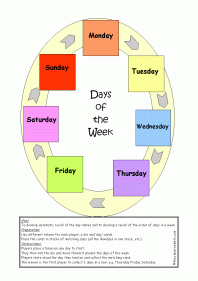
Other high frequency words that have been included in games include colours, number names, months and days.
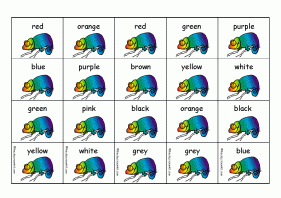
Colour Word Match Game A board game for learners to become familiar with the colour names.
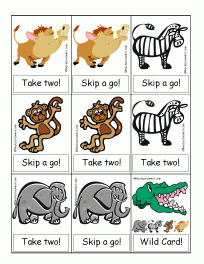
Ocean Creatures -sight words card game A card game where players take turns to pull cards from the container and state aloud what the sight word is. If it is correct, the player keeps it. The player with the most word cards at the end of the game is the winner. This game provides lots of repetition with 18 of the most used sight words. There are special cards to add interest to the game.
Pirates Ahoy-sight words card game A card game where players take turns to pull cards from the container and state aloud what the sight word is. If it is correct, the player keeps it. The player with the most word cards at the end of the game is the winner. This game provides lots of repetition with 18 of the most used sight words. There are special cards to add interest to the game.
Scarecrow - sight words card game A card game to provide learners with opportunities to see and read 18 basic sight words. Repetition of the words helps to build the learner's automaticity, which then aids fluency in reading.
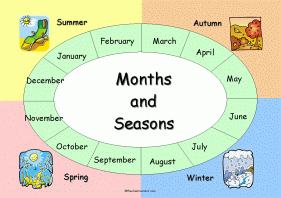
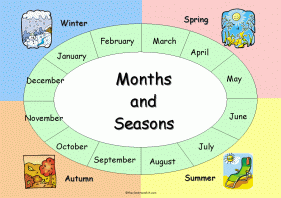
A board game to assist leaners to become familiar with the order of the months and the months in each season. This game is also useful to assist with reading the months as sight words.
48 colour name cards and 12 bug cards (Mmm, lunch!) Develops automaticity with colour names.
The Quest For Golden Treasures
Set 1 (Print in A3 if possible)
This game gives players lots of repetition with the most common sight words. Players place their counter on any word to start. Take turns to roll a die, and move that many spaces in either direction. The player reads the word aloud that he lands on. If he lands on the same word as one in the centre, he takes the card from the board. Another word card is then turned over to replace the card that has been won. The first player to collect 5 cards is the winner.
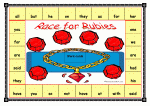
Race for RubiesFree resource Set 2 (Print in A3 if possible)
This game gives players lots of repetition with the most common sight words. Players place their counter on any word to start. Take turns to roll a die, and move that many spaces in either direction. The player reads the word aloud that he lands on. If he lands on the same word as one in the centre, he takes the card from the board. Another word card is then turned over to replace the card that has been won. The first player to collect 5 cards is the winner.
Sailing the Blue-Green Sea Sets 3 and 4 (Print in A3 if possible)
This game gives players lots of repetition with the most common sight words. Players place their counter on any word to start. Take turns to roll a die, and move that many spaces in either direction. The player reads the word aloud that he lands on. If he lands on the same word as one in the centre, he takes the card from the board. Another word card is then turned over to replace the card that has been won. The first player to collect 5 cards is the winner.
In Search of the Ancient Tomb set 5 (Print in A3 if possible)
This game gives players lots of repetition with the most common sight words. Players place their counter on any word to start. Take turns to roll a die, and move that many spaces in either direction. The player reads the word aloud that he lands on. If he lands on the same word as one in the centre, he takes the card from the board. Another word card is then turned over to replace the card that has been won. The first player to collect 5 cards is the winner.
Lost in Space set 6 (Print in A3 if possible)
This game gives players lots of repetition with the most common sight words. Players place their counter on any word to start. Take turns to roll a die, and move that many spaces in either direction. The player reads the word aloud that he lands on. If he lands on the same word as one in the centre, he takes the card from the board. Another word card is then turned over to replace the card that has been won. The first player to collect 5 cards is the winner.
In a Kingdom Far Away... Set 7 (Print in A3 if possible)
This game gives players lots of repetition with the most common sight words. Players place their counter on any word to start. Take turns to roll a die, and move that many spaces in either direction. The player reads the word aloud that he lands on. If he lands on the same word as one in the centre, he takes the card from the board. Another word card is then turned over to replace the card that has been won. The first player to collect 5 cards is the winner.
(a set of 12 different boards; students play in pairs)
The teacher calls the words, and students place a counter on the matching words on their boards.
Lift Off!
A card game with lots of repetition of the focus words.
There is a set of cards for each of the 1st hundred Wild Words lists.
These sets can be mixed or kept in their word groups as made. There are 30 words (and 23 Lift Off cards) in each set of cards. Suggestions for organisation:
Each set of cards could be printed on a different colour so they are distinguishable from each other. Before laminating, each card could be marked in some way to show which set they belong to.
A card game with lots of repetition of the focus words.
There is a set of cards for each of the 1st hundred Wild Words lists.
These sets can be mixed or kept in their word groups as made. There are 30 words (and 23 Strike cards) in each set of cards. Suggestions for organisation:
Each set of cards could be printed on a different colour so they are distinguishable from each other. Before laminating, each card could be marked in some way to show which set they belong to.
A card game with lots of repetition of the focus words.
There is a set of cards for each of the 2nd hundred Wild Words lists.
These sets can be mixed or kept in their word groups as made. There are 30 words (and 23 bad apples) in each set of cards.
Suggestions for organisation:
Each set of cards could be printed on a different colour so they are distinguishable from each other. Before laminating, each card could be marked in some way to show which set they belong to.
(these are a mixture of several games to add interest for older readers)
Card games with lots of repetition of the focus words.
There is a set of cards for each of the 2nd hundred Wild Words lists.
These sets can be mixed or kept in their word groups as made. In Gone Fishing! there are 30 words, 4 broken line cards, 6 need more worms cards, and 4 puzzle pieces in each game. In Autumn Leaves there are 30 words, 4 burn off cards, 6 make some mulch cards, and 4 puzzle pieces in each game.
(Really simple: keep taking cards until you pull out an Ouch! card. Then the next player gets a turn.)
A card game with lots of repetition of the focus words.
There is a set of cards for each of the 2nd hundred Wild Words lists.
These sets can be mixed or kept in their word groups as made. There are 30 words (and 23 ouch cards) in each set of cards.
Wild Words Uno Instructions: Deal 6 cards to each player and place the rest face down in a stack. Place 1 card face up on the table to begin the game. Players take it in turns to place a card on top that matches the last one played. If players can not place a card, they take a card from the stack. The first person to use all their cards is the winner. Words must be said aloud as they are played. Matches can be made with the same picture, the same word, or the same action card.








 Bad Apple!